Fuelnetwork combines FuelVM execution with Sway development for Ethereum rollup applications
Fuelnetwork is an Ethereum rollup platform built around FuelVM and the Sway programming language. Fuel Ignition is its Ethereum layer-2 network, where applications use that technology. Wallets connect users to applications, a bridge provides an asset entry path and development tools support the creation of new applications.
How Do Fuel Ignition, FuelVM and Sway Differ?
Fuel Ignition is the Ethereum layer-2 network, FuelVM executes its transactions and Sway supplies the language for writing its programs. These names identify different parts of the same technology stack. A decentralized exchange or lending application runs on the network and uses the execution environment. Its contract logic can use Sway, while its interface can use a separate application language.
FuelVM has its own transaction model, distinct from Ethereum's EVM. Sharing Ethereum's rollup setting does not make those execution environments interchangeable.
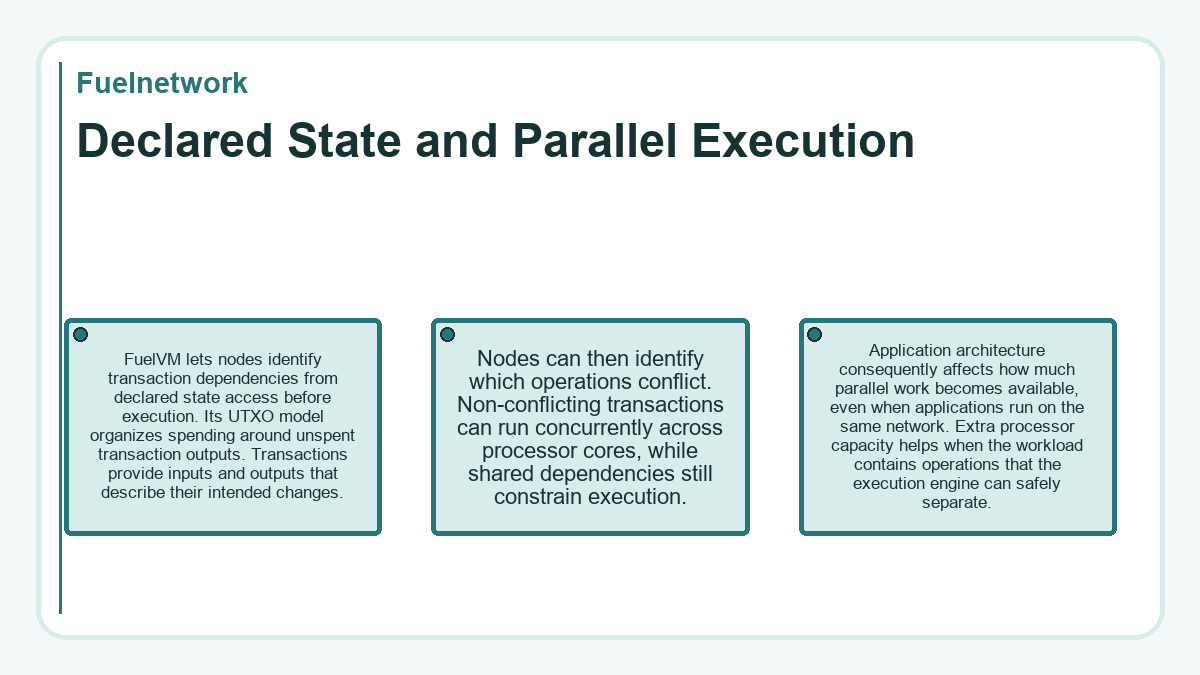
Declared State and Parallel Execution
FuelVM lets nodes identify transaction dependencies from declared state access before execution. Its UTXO model organizes spending around unspent transaction outputs. Transactions provide inputs and outputs that describe their intended changes. Nodes can then identify which operations conflict. Non-conflicting transactions can run concurrently across processor cores, while shared dependencies still constrain execution. Application architecture consequently affects how much parallel work becomes available, even when applications run on the same network. Extra processor capacity helps when the workload contains operations that the execution engine can safely separate.
Wallet Access, Bridging and Application Choice
Wallet compatibility determines how an application can connect to an account and request signatures on Fuel Ignition. A compatible wallet supplies the account connection, while a bridge moves supported assets between networks. The native Fuel Bridge provides a transfer path from Ethereum to Fuel Ignition. Native account abstraction is part of the platform, and application-level wallet integrations determine the connection options that a particular interface presents.
Ecosystem examples include MIRA DEX for exchange activity, Swaylend for lending and Griffy for prediction markets.
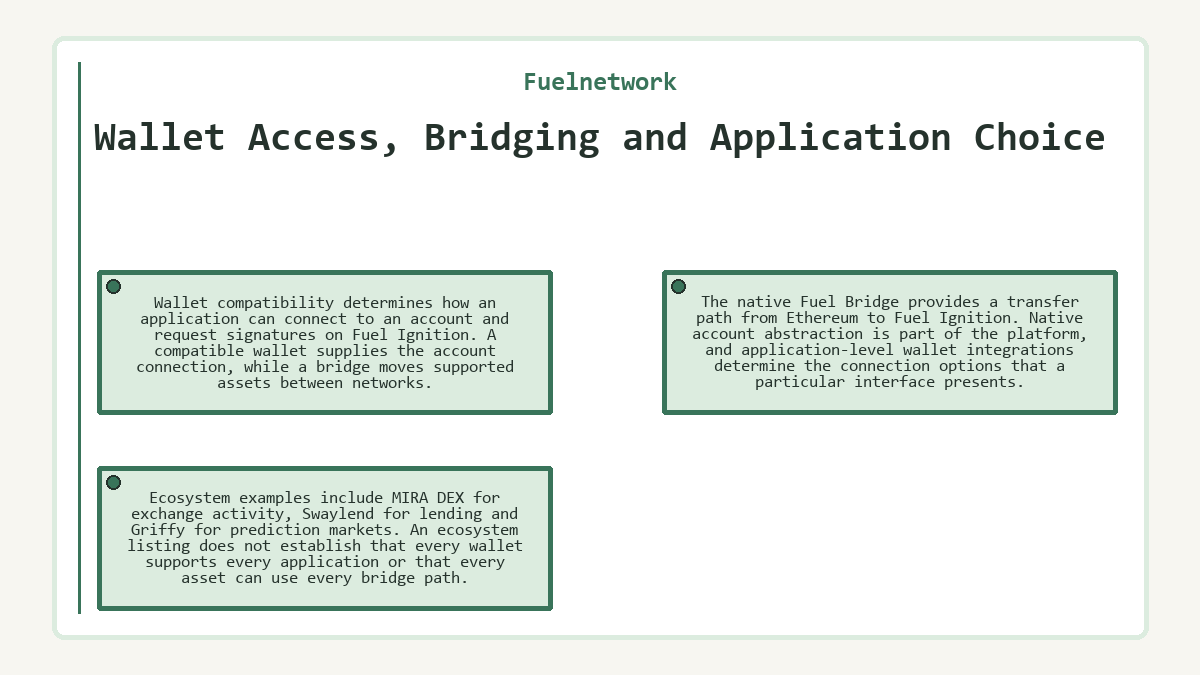
An ecosystem listing does not establish that every wallet supports every application or that every asset can use every bridge path.
Native Assets and Programmable Spending
FuelVM provides native assets alongside programmable spending conditions, giving applications tools for handling assets without putting every rule in persistent contract storage. FuelVM supports multiple native assets. Assets controlled by predicates have programmable spending conditions. A predicate is a stateless program that returns a Boolean result; if it returns false, the transaction is invalid. This connects authorization to the transaction that spends the affected asset. Predicates have no persistent storage and cannot call contracts.
Scripts guide transaction execution and can call contracts, while contracts retain persistent storage. Intent-driven exchanges can use spending conditions to express requirements for transaction inputs and outputs. Automated market maker (AMM) designs can combine spending conditions with native assets without using smart contracts. Smart contracts remain available for applications that need persistent state; the alternative design does not describe every exchange on Ignition.
From Toolchain Selection to Testnet Deployment
A Sway contract targeting testnet uses compatible tools managed by Fuelup, while Forc handles project creation, building, testing and deployment. Compilation, testing and publication answer different questions about that contract. A successful build establishes that the compiler accepts the program. Tests exercise the behavior covered by their cases. Successful deployment publishes the contract to the selected network, using a signing account with funds in that environment.
| Development Stage | Tool | Operation | Requirements and Limits |
|---|---|---|---|
| Toolchain Selection | Fuelup | Select the testnet toolchain | Mainnet and testnet use separate channels |
| Project Creation | Forc | Initialize a Sway contract project | Creates local files without publishing a contract |
| Build | Forc | Compile the contract | Does not establish application correctness |
| Test | Forc | Run the project's test cases | Coverage depends on the cases defined |
| Testnet Deployment | Forc and a signing wallet | Submit the contract deployment | Requires a funded signing account on testnet |
| A contract deployed to testnet belongs to that environment; Fuel Ignition uses the separate mainnet environment. | |||
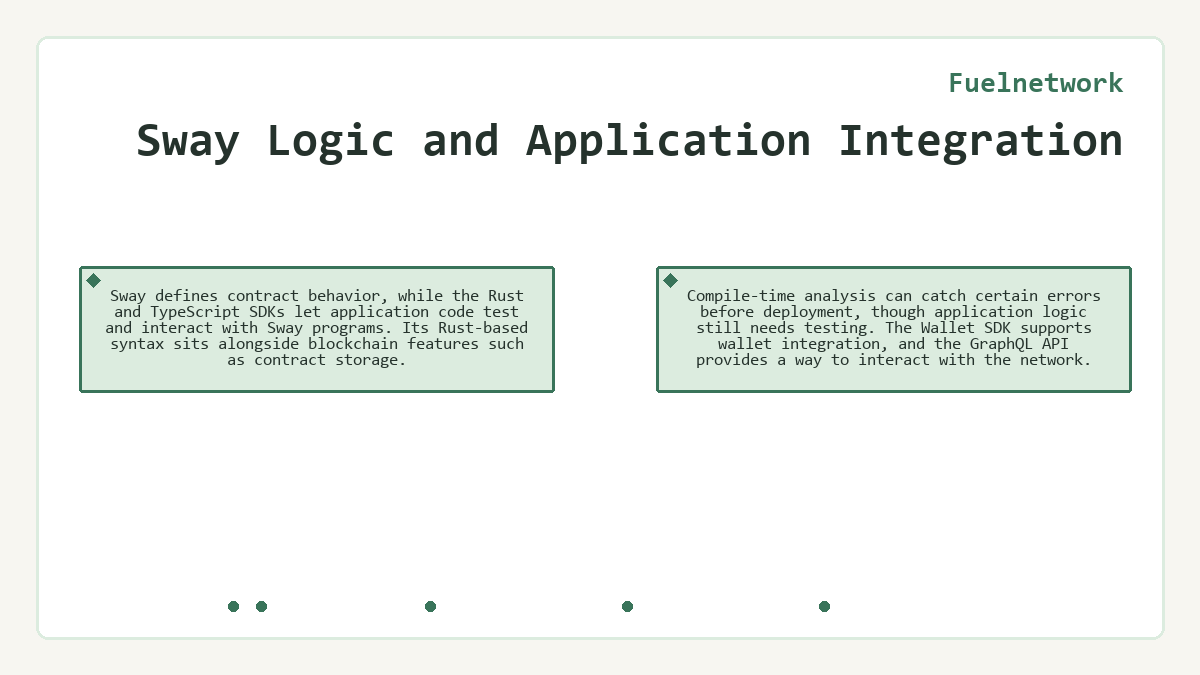
Sway Logic and Application Integration
Sway defines contract behavior, while the Rust and TypeScript SDKs let application code test and interact with Sway programs. Its Rust-based syntax sits alongside blockchain features such as contract storage. Compile-time analysis can catch certain errors before deployment, though application logic still needs testing. The Wallet SDK supports wallet integration, and the GraphQL API provides a way to interact with the network.
Ethereum Data Availability and Version Boundaries
Fuel Ignition uses Ethereum for data availability, while FuelVM supplies the execution environment that processes application transactions. Data availability concerns access to the data needed to verify rollup activity. Execution capacity and data publication therefore describe different parts of the network's relationship with Ethereum.
Fuel V1 was an earlier optimistic rollup that launched on Ethereum mainnet in 2020. Its historical Stage 2 classification concerns that version.
Ignition's architecture also aims to keep node verification accessible on consumer hardware through state-minimized execution. A processing benchmark describes its workload and hardware; it does not set a completion deadline for a bridge transfer.
Fuelnetwork: reader questions
What Token Pays Transaction Fees on Fuel Ignition?
Fuel Ignition uses ETH as its gas token. Gas pays for transaction execution on that network. The asset used to pay network fees is a separate detail from the assets that an application accepts for its own operations.
Can I Experiment With Sway in a Browser?
Sway Playground provides a browser environment for experimenting with the language. It offers a way to explore Sway without first setting up the full local toolchain. Contract deployment and application integration involve additional tools and environment choices.
Do I Need Rust Installed to Use Every Fuel Development Tool?
Developing with the Rust SDK requires a Rust installation; the standard toolchain installation treats Rust as optional otherwise. Sway's Rust-based syntax does not by itself create that requirement for every development path. The TypeScript SDK provides a separate way to test and interact with Sway programs.
Does Fuelup's Latest Channel Select the Newest Compiler?
Fuelup's latest channel is an alias for mainnet, not a promise of the newest upstream compiler. Testnet development uses the separate testnet channel. The nightly channel contains development tooling and does not promise compatibility with a particular network.
Is Windows a Native Platform for Fuelup?
Fuelup's installation path on Windows uses Windows Subsystem for Linux because the installer does not provide native Windows support; this requirement concerns the local development toolchain.
Where Can I Get Tokens for Fuel Testnet?
The Fuel Faucet provides tokens for Fuel Testnet. A Fuel wallet address is required to receive them. This development path uses the testnet environment, so it does not fund a Fuel Ignition mainnet account.
How Can I Inspect a Fuelnetwork Transaction?
The block explorer lets you inspect transactions on the Fuel network. Fuel Ignition and Fuel Testnet have separate explorers, so use the one for the network where the transaction occurred.