Fuelnetwork uses finalized commitments and message proofs to return native ETH to Ethereum
Fuelnetwork moves native ETH from Fuel Ignition back to Ethereum through a withdrawal message that must clear the bridge's finalization checks. The Fuel transaction removes the withdrawn ETH from the sender's spendable layer-2 balance and creates a MessageOut receipt naming the Ethereum recipient. Once the relevant commitment finalizes, a relay transaction submits the message and its Merkle proofs to the Fuel Message Portal on Ethereum. Successful execution releases ETH to that recipient. A successful Fuel withdrawal transaction records its initiation, while a successful Ethereum relay records the release. The challenge window affects eligibility; it does not promise an exact arrival time.
The challenge window starts from the relevant Ethereum commitment, so a Fuel transaction timestamp alone cannot determine claim readiness.
Native ETH and Token Gateway Withdrawals
Native ETH withdrawals carry value in an outbound message, while bridged ERC-20 withdrawals use a gateway call to release the corresponding token.
Native ETH Release
Native ETH follows the message's amount and Ethereum recipient. The Message Portal holds ETH on Ethereum and releases it when the outbound message passes its checks. This route returns ETH from Fuel Ignition to Ethereum mainnet. It involves distinct network balances, even when the wallet interface displays the same asset symbol throughout the transfer.
Bridged Token Release
A bridged ERC-20 withdrawal directs its outbound message to an Ethereum token gateway. The message's data tells that gateway which withdrawal to finalize. The gateway then releases the token to its intended recipient. ETH used to pay transaction fees remains separate from that token.
The Fuel Transaction and Its MessageOut Receipt
FuelVM executes the withdrawal transaction and produces a MessageOut receipt that records the outbound ETH message, including its recipient and amount. The withdrawal removes its ETH value from the spendable layer-2 supply. A Fuel transaction hash identifies the transaction, while the receipt describes the withdrawal that the portal must process. A balance reduction can include transaction costs, so it does not independently establish the message amount. Parallel execution concerns Fuel transaction processing; Ethereum commitment finalization remains a separate requirement.
How Long Does an ETH Withdrawal Take?
An ETH withdrawal becomes eligible for relay after the relevant Ethereum commitment finalizes; total waiting time also includes commitment publication and relay execution.
The Commitment Timestamp
Ethereum receives commitments to Fuel chain history through the FuelChainState contract. Each commitment records an Ethereum timestamp. The applicable finalization interval runs from that commitment, rather than the moment a wallet signs the Fuel transaction. Time between layer-2 inclusion and publication of the relevant commitment adds to the wait. A countdown based only on the original transaction time can therefore misrepresent the claim's readiness.
The Applicable Finalization Interval
The mainnet Fuel Book describes a seven-day challenge window for this native withdrawal mechanism. The deployed chain-state contract supplies the applicable
TIME_TO_FINALIZE
setting and determines whether a commitment has finalized. Seven days describes that documented interval, not a maximum duration from signing to receipt. Even after eligibility begins, an Ethereum relay still has to execute successfully.
The Merkle Proofs Behind the ETH Claim
A Merkle proof lets the portal verify a withdrawal against committed Fuel history without treating the wallet's displayed status as authority. One proof connects the message to its Fuel block. Another connects that block to committed chain history represented by a root block. The Fuel Message Portal requires valid inclusion proofs before relaying an ETH withdrawal to Ethereum. The message includes its sender, recipient, nonce, amount and data. Altering those fields changes the message being proved. Proof generation and verification concern those recorded values, so manually substituting an amount cannot modify the existing withdrawal.
Recipient Addresses and ETH Release
The Ethereum recipient in the withdrawal message determines where the portal sends ETH when it executes a successful native claim. That address belongs to Ethereum, even though the initiating transaction runs on Fuel. The sending account's Fuel address identifies the starting side and does not substitute for the Ethereum destination. The portal's recipient call carries the withdrawal value. A receiving contract must accept that call for execution to succeed. A rejected recipient call leaves the relay unsuccessful, so a finalization countdown reaching zero cannot establish that funds reached the address.
ETH Fees on the Starting and Destination Networks
Fuel Transaction Costs
Fuel Ignition uses ETH for transaction fees as well as the native withdrawal amount. When the initiating account pays its own execution fee, its Fuel balance must cover that fee alongside the withdrawal. Keep the transfer amount separate from its estimated execution cost when reviewing the request.
Ethereum Relay Costs
Ethereum also charges gas for the relay transaction that executes the claim. An account submitting its own relay needs enough ETH on Ethereum to pay that transaction's cost. ETH awaiting release inside the bridge does not already sit in the submitting account's spendable balance. The fee estimate can change with Ethereum conditions and the transaction's execution. A low Fuel transaction fee cannot establish the total cost of returning ETH to Ethereum.
What Confirms That a Withdrawal Has Finished on Ethereum?
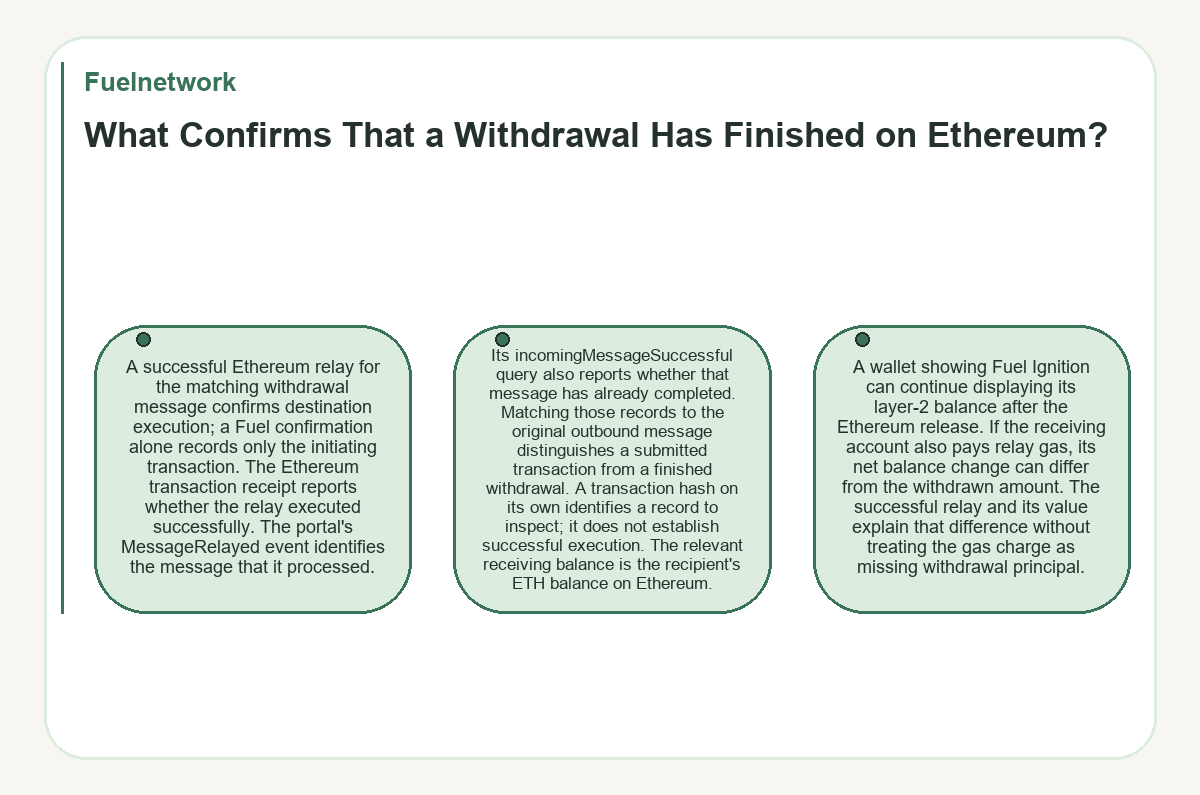
A successful Ethereum relay for the matching withdrawal message confirms destination execution; a Fuel confirmation alone records only the initiating transaction.
The Ethereum transaction receipt reports whether the relay executed successfully. The portal's
MessageRelayed
event identifies the message that it processed. Its
incomingMessageSuccessful
query also reports whether that message has already completed. Matching those records to the original outbound message distinguishes a submitted transaction from a finished withdrawal. A transaction hash on its own identifies a record to inspect; it does not establish successful execution.
The relevant receiving balance is the recipient's ETH balance on Ethereum. A wallet showing Fuel Ignition can continue displaying its layer-2 balance after the Ethereum release. If the receiving account also pays relay gas, its net balance change can differ from the withdrawn amount. The successful relay and its value explain that difference without treating the gas charge as missing withdrawal principal.
Bridge Pauses and Withdrawal Limits
FuelMessagePortalV3 can pause withdrawals or block individual messages, and it supports an ETH rate limit that administrators can enable or disable. These controls add conditions beyond proof validity and commitment age. A withdrawal pause can reject a matured claim. A blocked message needs its restriction removed before the portal can process it. Neither condition establishes that the layer-2 withdrawal transaction failed.
When enabled, the ETH rate limit caps the aggregate amount that the portal allows during its configured period. The allowance covers ETH withdrawals across accounts using that portal. A claim can exceed the remaining allowance after other withdrawals consume capacity. If a single message exceeds the full configured limit, waiting for another period alone cannot make it fit. The configured allowance governs that restriction; an elapsed challenge window does not override it.
Claim Readiness Before and After Commitment Finalization
Does a visible MessageOut receipt make a withdrawal ready for Ethereum? Compare the same native ETH message with valid proofs before and after its referenced commitment finalizes. Keep its amount and recipient unchanged, with the message still unrelayed and the recipient able to accept the ETH transfer. Assume that no applicable bridge restriction blocks execution.
A finalized commitment allows the portal to accept the proof-backed claim and execute its ETH transfer. Successful Ethereum execution supplies the release evidence. If that commitment has not finalized, the portal rejects the relay at its finalization check. The receipt can already exist in both cases. Changing only the commitment's maturity changes eligibility, even though the withdrawal details remain identical. Waiting allows the required interval to pass; repeated submission cannot bring finalization forward.
Before continuing with the Ethereum claim, check the conditions for that same message:
- Fuel Ignition is the starting network and Ethereum is the receiving network.
- The MessageOut recipient and ETH amount match the intended withdrawal.
- The referenced commitment has finalized under the applicable chain-state setting.
- The proofs match the message and its committed block history.
- The portal has not already relayed the message and no applicable restriction blocks the claim.
- The account submitting the relay can fund its Ethereum gas.
Proof Errors and Claim Recovery
An invalid proof error concerns the message or its relationship to committed history. Waiting longer does not repair mismatched proof data. The message's block and the root block used to prove history must correspond to the supplied proofs. An unfinalized-block error instead concerns timing, so the referenced commitment's status controls relay eligibility. These failures require different responses even when a wallet displays a similar generic failure message.
A recipient-call failure concerns execution at the Ethereum destination. Repeated submission with unchanged conditions can repeat the failure and consume gas. An already-relayed response calls for inspecting the existing successful Ethereum record, rather than initiating another Fuel withdrawal. A failed Ethereum claim does not, by itself, establish that the original Fuel withdrawal reverted. The existing message's status determines whether another relay attempt has a purpose.
Fuelnetwork FAQs
Can Another Account Relay My Fuelnetwork ETH Withdrawal?
Any account can call relayMessage with the required message and proofs, subject to the portal's checks. The message's Ethereum recipient determines who receives ETH. A different caller cannot redirect the withdrawal by submitting it. The submitting account also needs a way to fund the Ethereum transaction's gas.
Does a Native ETH Claim Need an ERC-20 Token Approval?
The native ETH release uses the portal's ETH transfer mechanism, so it does not require an ERC-20 allowance for the released asset. An approval authorizes spending of a token. It does not replace the message inclusion proofs or the finalization check required for this ETH claim.
Do I Need My Fuel Secret Recovery Phrase to Produce a Withdrawal Proof?
A withdrawal inclusion proof uses public message and block data, without requiring your wallet's secret recovery phrase. The account submitting the Ethereum relay authorizes that transaction separately. Providing a recovery phrase to a proof tool is not part of the portal's message-verification mechanism.
Will a Faster Finality Announcement Make My Existing ETH Claim Ready?
A faster finality announcement does not change a claim's eligibility unless an applicable deployed protocol change alters its finalization rules. Fuel has discussed hybrid proving to reduce challenge windows. The native relay evaluates the relevant commitment through its chain-state contract, so an announcement alone supplies no new finalization state for that message.
Why Does a Raw Withdrawal Amount Differ From an Ethereum Wei Amount?
Fuel Ignition's native ETH message amount uses nine decimal places, while Ethereum expresses ETH in wei with eighteen decimal places. The portal multiplies the raw message amount by one billion to express the same ETH value in wei. Those integers use different scales; the conversion does not multiply the withdrawal's economic value.
Is Fuel Testnet ETH Claimable as Ethereum Mainnet ETH?
Fuel Testnet ETH is a test asset and does not become Ethereum mainnet ETH through the Fuel Ignition withdrawal route. Fuel Testnet and Fuel Ignition are different networks, even though both use ETH as the gas symbol. A testnet faucet balance is separate from the mainnet ETH that the native bridge holds on Ethereum.