Fuelnetwork parallel execution depends on UTXO inputs and shared contract state
Fuelnetwork parallel execution lets transactions with independent state changes run concurrently across processor cores. Fuel nodes identify dependencies through transaction inputs and access lists built around unspent transaction outputs, or UTXOs. A swap can therefore share an execution constraint with another transaction when both access the same contract. Available CPU capacity helps with independent work; transaction dependencies determine which operations must keep their order. A displayed balance alone does not reveal those relationships.
Swap Inputs and Shared Contract State
A contract-based exchange transaction combines spending rules with the application state that its contract calls use. Fuel represents spendable coins as individual outputs owned by addresses or predicates, so one address can hold several separately identified outputs. The transaction selects its funding coins and declares any contracts that the action needs. These inputs describe different dependencies, so distinct funding coins do not by themselves establish an independent swap.
Stateful contracts keep values between calls, so swaps that depend on the same contract state must preserve their dependencies. Native transfers without contract calls avoid that particular shared state. The relevant constraint follows the state that the transaction accesses.
Can All Fuel Transactions Run at Once?
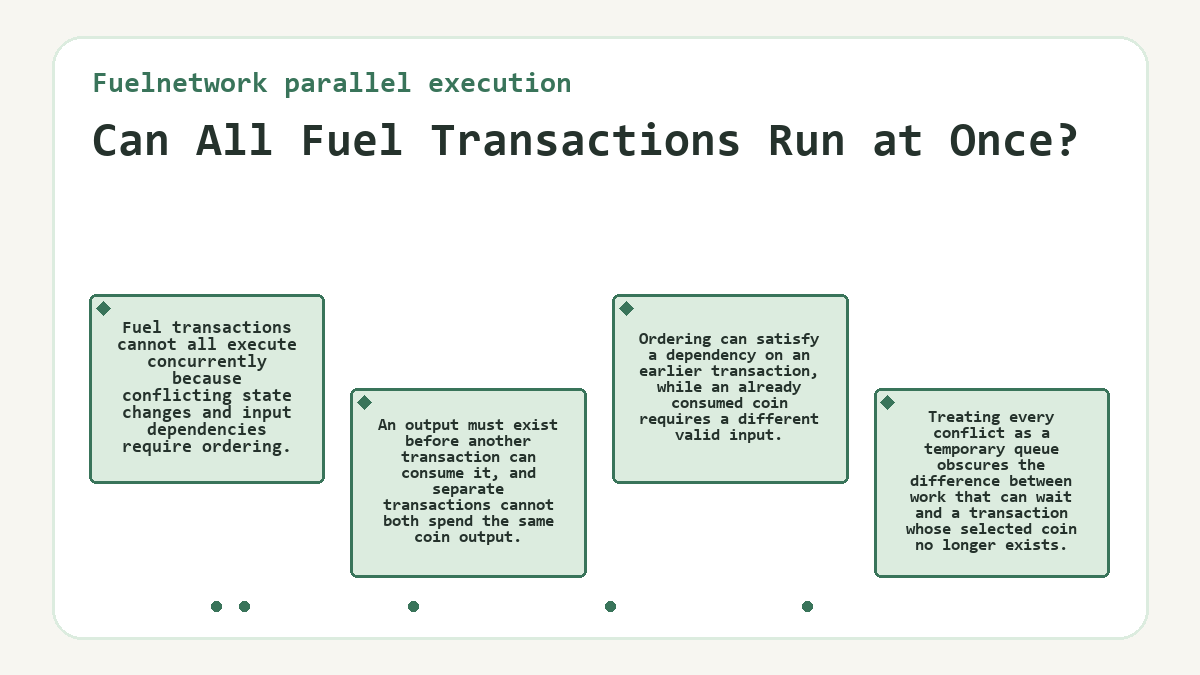
Fuel transactions cannot all execute concurrently because conflicting state changes and input dependencies require ordering. An output must exist before another transaction can consume it, and separate transactions cannot both spend the same coin output. Ordering can satisfy a dependency on an earlier transaction, while an already consumed coin requires a different valid input. Treating every conflict as a temporary queue obscures the difference between work that can wait and a transaction whose selected coin no longer exists.
Access Lists and Dependency Order
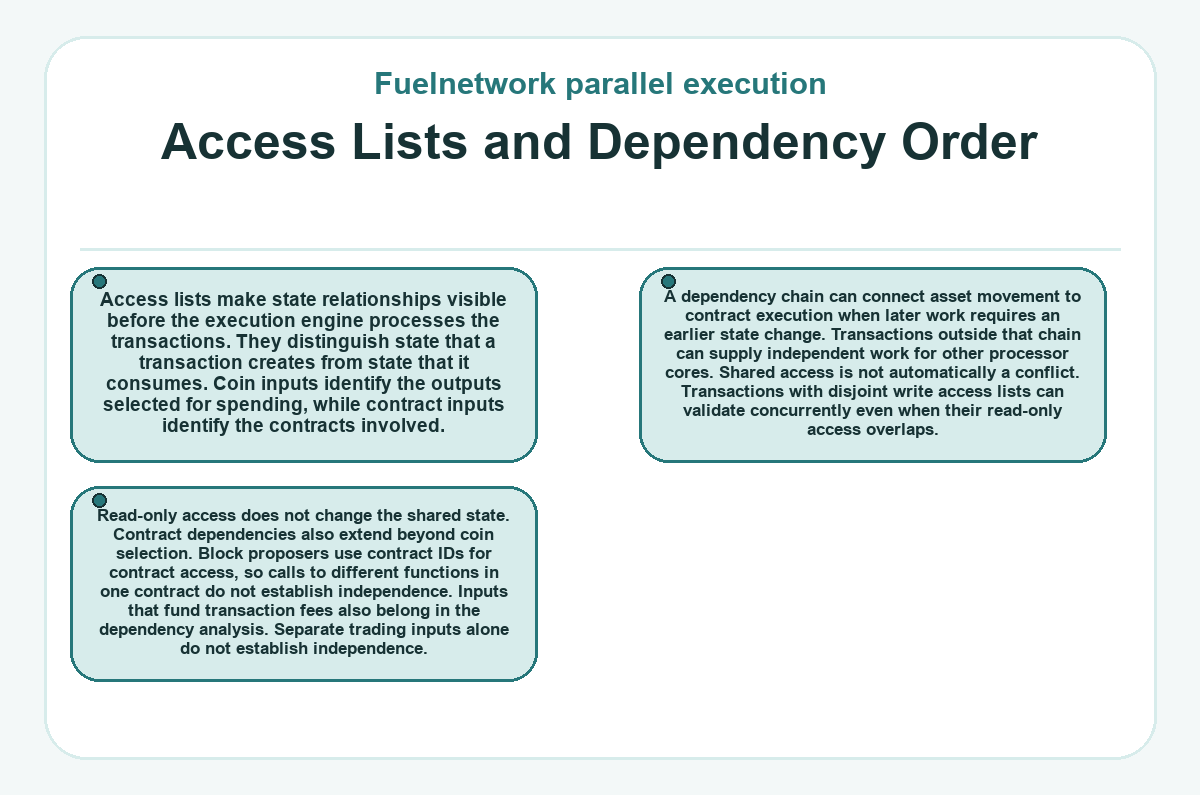
Access lists make state relationships visible before the execution engine processes the transactions. They distinguish state that a transaction creates from state that it consumes. Coin inputs identify the outputs selected for spending, while contract inputs identify the contracts involved. A dependency chain can connect asset movement to contract execution when later work requires an earlier state change. Transactions outside that chain can supply independent work for other processor cores.
Shared access is not automatically a conflict. Transactions with disjoint write access lists can validate concurrently even when their read-only access overlaps. Read-only access does not change the shared state.
Contract dependencies also extend beyond coin selection. Block proposers use contract IDs for contract access, so calls to different functions in one contract do not establish independence.
Inputs that fund transaction fees also belong in the dependency analysis. Separate trading inputs alone do not establish independence.
State Minimization Within an Application
Native assets and stateless programs let applications express some behavior without adding persistent contract storage. Fuel predicates validate spending conditions against the transaction that consumes their coins. They can inspect inputs and outputs, including conditions that require a receiving asset to go to a particular address. A contract-based exchange keeps persistent application state; a predicate expresses its spending condition without persistent storage. Stateless code still operates on specific inputs, and spending a predicate-owned coin consumes that output under its conditions.
Scripts written in Sway coordinate transaction logic and can call the contracts included as inputs. A contract call brings that contract's state into the dependency analysis. Combining calls inside a script supports complex application behavior, including interactions across an exchange and a lending protocol. Persistent application storage still requires contracts. A script can coordinate access to that storage without keeping persistent storage of its own.
Does More CPU Capacity Make Every Swap Faster?
Additional CPU cores help when a workload contains independent transactions; shared dependencies still constrain how much work can overlap. More processor capacity cannot make an unavailable input exist or remove a dependency between state changes. A workload concentrated on shared state has fewer independent operations than one with disjoint accesses. This is a property of that workload, so a throughput figure from another transaction mix cannot predict the duration of a particular swap. A transaction's computational cost also affects how much processing time it requires.
FuelVM's register-based design concerns instruction execution, while transaction parallelization concerns which separate transactions the engine can process concurrently.
Spendable Inputs Before a Repeat Swap
Consider a repeated swap funded from an address whose displayed balance remains sufficient. The prepared transaction names particular coin outputs, and those outputs must still exist when the transaction needs them. If an earlier transaction spends one of those coins, it changes which outputs remain available. A change output can preserve part of the address's balance while giving that value a new output identity. The single-spend rule remains the same; the availability of each selected output changes with transaction activity.
When preparing another swap, compare its selected inputs with the current spendable outputs and apply the relevant conditions:
Fuelnetwork parallel execution - UTXO Dependencies
- State Minimization Within an Application
- Does More CPU Capacity Make Every Swap Faster?
- Spendable Inputs Before a Repeat Swap
- Performance Claims Against the Workload
- If a selected coin output is already spent, exclude it from the next transaction.
- If another transaction creates an input that the swap needs, preserve that dependency.
- If transactions call the same contract, include that shared access when assessing their independence.
- If a predicate requires a receiving output, preserve its asset, amount and recipient.
- If execution reports failure, do not infer that the swap produced the intended receiving coins.
If a required coin input no longer exists, rebuild the transaction with available coins that cover its required assets and fees before authorizing the new version. The earlier preparation stops being usable once another transaction spends a selected coin, even if change keeps the displayed balance high.
Performance Claims Against the Workload
Throughput describes transaction work per unit of time, while swap latency measures how long a particular action takes. Both measurements need context about contract access and transaction complexity. A code change that adds a contract call can change the dependencies of the trading action. Performance comparisons therefore need the applicable application version, network configuration and hardware. Independent asset transfers do not exercise the same dependencies as repeated operations against shared application state. A headline rate also does not identify which part of a transaction's elapsed time came from execution.
The next design decision concerns which operations require persistent shared state. Keep those dependencies explicit when assessing a swap and compare performance under the intended transaction mix and available hardware.
Fuelnetwork parallel execution: questions and answers
How Does Fuel Identify the Coin Output That a Transaction Spends?
Fuel identifies a coin output by its creating transaction ID and its output index. These identify a specific UTXO. The owner, asset ID and amount describe other properties of that coin. Matching an asset and balance does not establish that two transactions select different outputs.
Can One Fuel Address Have Transactions Eligible for Concurrent Execution?
Transactions from one address can qualify for concurrent execution when their accesses do not conflict. Separate unspent coin outputs can provide distinct inputs, although shared contract access can still create dependencies. Address ownership alone therefore does not decide whether the transactions form independent work.
Does a Sway Storage Annotation Control Transaction Scheduling?
Sway storage annotations declare the persistent storage access that a function requires. They do not establish that separate transactions have disjoint access lists. A function marked for reading still belongs to its contract, and callers must account for the transaction's complete set of inputs and contract dependencies.
Is Successful Predicate Verification Proof That a Swap Completed?
Successful predicate verification establishes that the predicate's spending conditions passed for that transaction. FuelVM then executes any transaction script and its contract calls. Those operations can encounter their own failures. Predicate approval alone therefore does not establish that the exchange produced the intended receiving output.
Are Multicall Scripts Automatically Parallel Inside a Fuel Transaction?
Multicall support establishes that a script can coordinate several contract calls within one transaction. It does not establish that those calls run simultaneously. Fuel's transaction parallelization depends on independence between transactions. Combining calls also brings their contract inputs into the dependencies of the combined transaction.
Will Increasing Forc Test Threads Increase Mainnet Throughput?
Increasing Forc test threads changes how many threads the local test runner uses. The setting does not configure Fuel Ignition's transaction processing. Tests can check program behavior, but their thread count does not establish the concurrency available to a deployed application under shared state dependencies.
Does Parallel Execution Shorten the Native ETH Withdrawal Challenge Window?
Parallel execution does not determine the native ETH withdrawal challenge window. The relevant Ethereum commitment must finalize before the withdrawal message becomes eligible for relay. Faster FuelVM transaction processing does not replace that condition or the later Ethereum relay that releases ETH to the recipient.